
Why Linear Chat is failing us
Linear chat is a brilliant tool—and the wrong one for learning and serious discussion

“If it ain’t broke don’t fix it” - Anon
“Never let the good be the ememy of the perfect” - Me 2026
For a few years I’ve been climbing as a hobby. When I started going several times a week, I did what everyone does: I bought the “right” shoes. I went to a specialist shop, tried on an absurd number of pairs, and eventually found the model that felt perfect. For years, I replaced them with the same pair whenever they wore out.
Then last year I changed—not because anything was broken, but because I realised “perfect” is often just “perfect for a narrow set of problems.” I tried a softer shoe. It was worse in some situations, better in others, and it nudged my climbing in a direction I didn’t know I’d been missing.

Climbing (?)
That’s the frame for what follows: sometimes the default tool feels so natural that we stop seeing its trade-offs.
And few tools are more “water-like” now than linear chat.
Slack at work. Discord for communities. Group chats for friends. Comment threads under posts. Even most AI “conversation” interfaces. We’ve normalised a single design assumption: messages arrive in a stream, so we read them in arrival order.
It’s not failing because it’s bad. It’s failing because it’s optimised for immediacy, and we keep using it for tasks that require structure, memory, and precise disagreement.
The hidden contract of linear chat
Linear chat quietly asks you to accept a contract:
The most recent message is the most relevant.
One stream can carry many conversations at once.
Meaning is carried by proximity and timing, not explicit structure.
That contract is great for coordination (“Where are we meeting?”), quick help (“Does anyone know…?”), and lightweight social glue.
But it breaks down in the places we increasingly ask it to serve: debate, collaborative thinking, decision-making, teaching, and “working something out” with other humans.
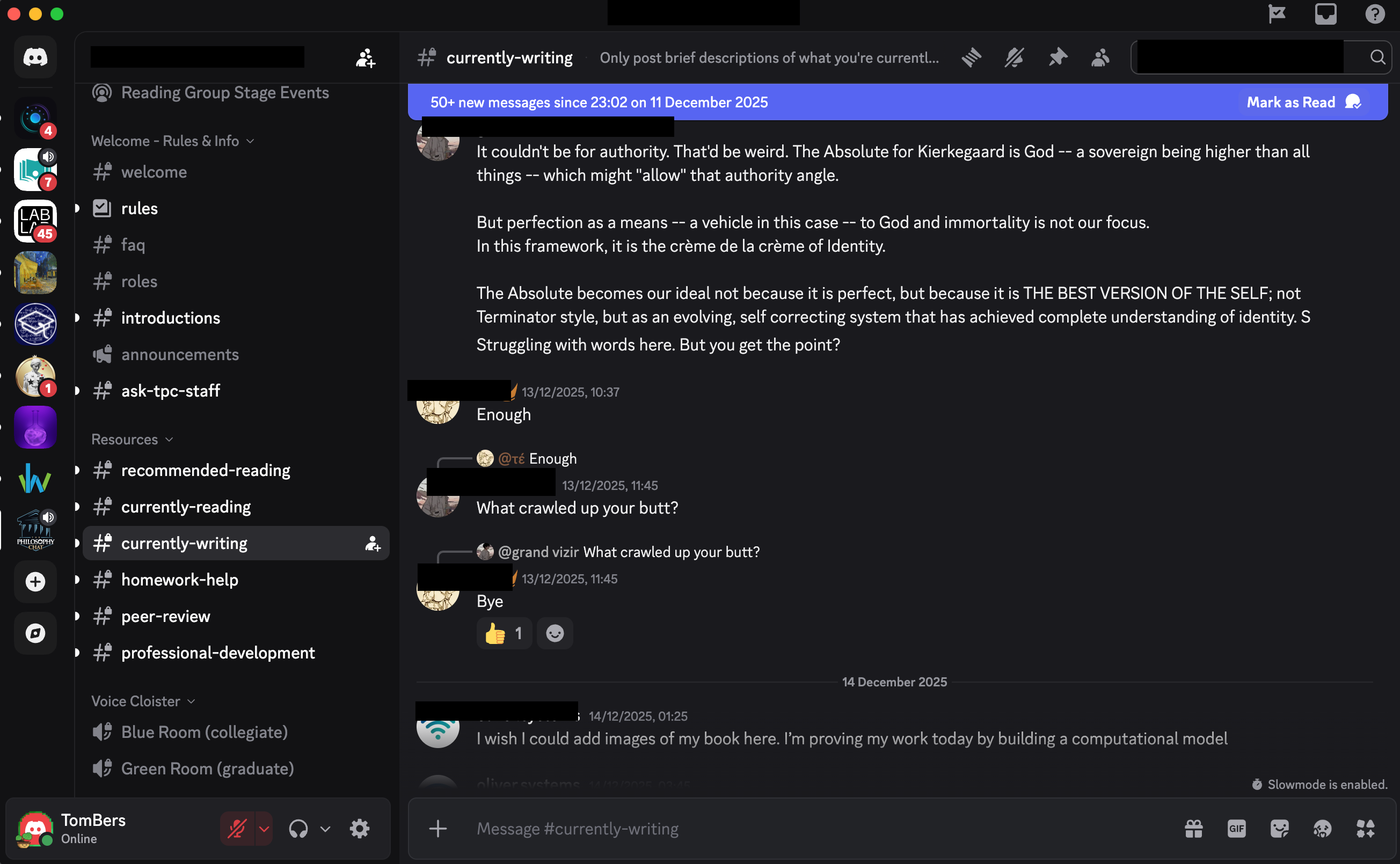
Online Philosophy
Failure mode 1: interleaving turns discussion into confusion
Here’s a scene you’ve lived:
Someone asks a question.
Three people respond in parallel.
A fourth person replies thoughtfully… to the first response.
Meanwhile the stream has moved on.
Now someone is “replying” to a reply to a reply, but half the participants only see a jumble of fragments.
If your tooling supports threading, you get some relief. But you also get a new problem: discussion splinters into hidden sub-conversations that are easy to miss, and impossible to summarise without doing a bunch of manual archaeology.
The incentive becomes either:
instant reactions (because latency makes you irrelevant), or
side channels (“Let’s take this to DMs / another channel / a call”), which removes the conversation from the shared record.
Either way, the group loses a stable, shared map of what was said.
Failure mode 2: context evaporates unless you were “there live”
At its best, chat feels like flow. Questions, answers, jokes, decisions—rapid fire. “Things get done.”
But step away for an hour, a day, a weekend, and you return to the modern equivalent of a desk covered in unsorted paper:
plans mixed with memes,
key decisions buried under emoji,
“important” messages indistinguishable from noise,
and a gnawing feeling that you’re missing something.
The stream doesn’t just store information. It stores time. If you weren’t present while the meaning was happening, the meaning becomes harder to reconstruct.
Failure mode 3: multi-claim messages collapse real disagreement
In serious discussion, people rarely make one claim at a time. They bundle points:
“X is wrong because A, B, and C—and also your example doesn’t work because D.”
A good debate tool would treat each claim as a branch: each point can be tested, answered, refined, or discarded without losing track of the others.
Linear chat does the opposite. It encourages:
one big reply to everything (which becomes another bundle), or
selective replies that look like “dodging” because there’s no shared structure showing what was addressed and what wasn’t.
This is where conflict sneaks in. Not because people are irrational—but because the medium makes good-faith disagreement look like bad faith.
Failure mode 4: social proof becomes the steering wheel
Reacts, likes, upvotes, “🔥,” dunk replies—these are not neutral. They optimise for:
speed,
visibility,
and emotional punch.
In some spaces that’s fine. In spaces where truth-seeking matters, it quietly turns discussion into performance. The hot take gets rewarded. The careful nuance gets buried. The “last word” wins, because the stream privileges recency.
So we end up spending enormous human effort building systems that maximise engagement while making it unnecessarily hard to retrieve the best thinking.
And then we act surprised when the outcomes feel shallow.
A different bet: what if conversation wasn’t a stream?
Here’s the alternative idea:
What if a conversation wasn’t something you “scroll,” but something you navigate?
Not a list of messages, but a map of claims, evidence, counterpoints, and synthesis.
That’s the bet behind MuDG.
MuDG takes the messy, linear chat dynamic and turns it into a visual map of how ideas branch, connect, and evolve—so you can go deep without losing the bigger picture.
Instead of asking you to keep the entire structure in your head (or in a thousand-message backlog), it externalises it.
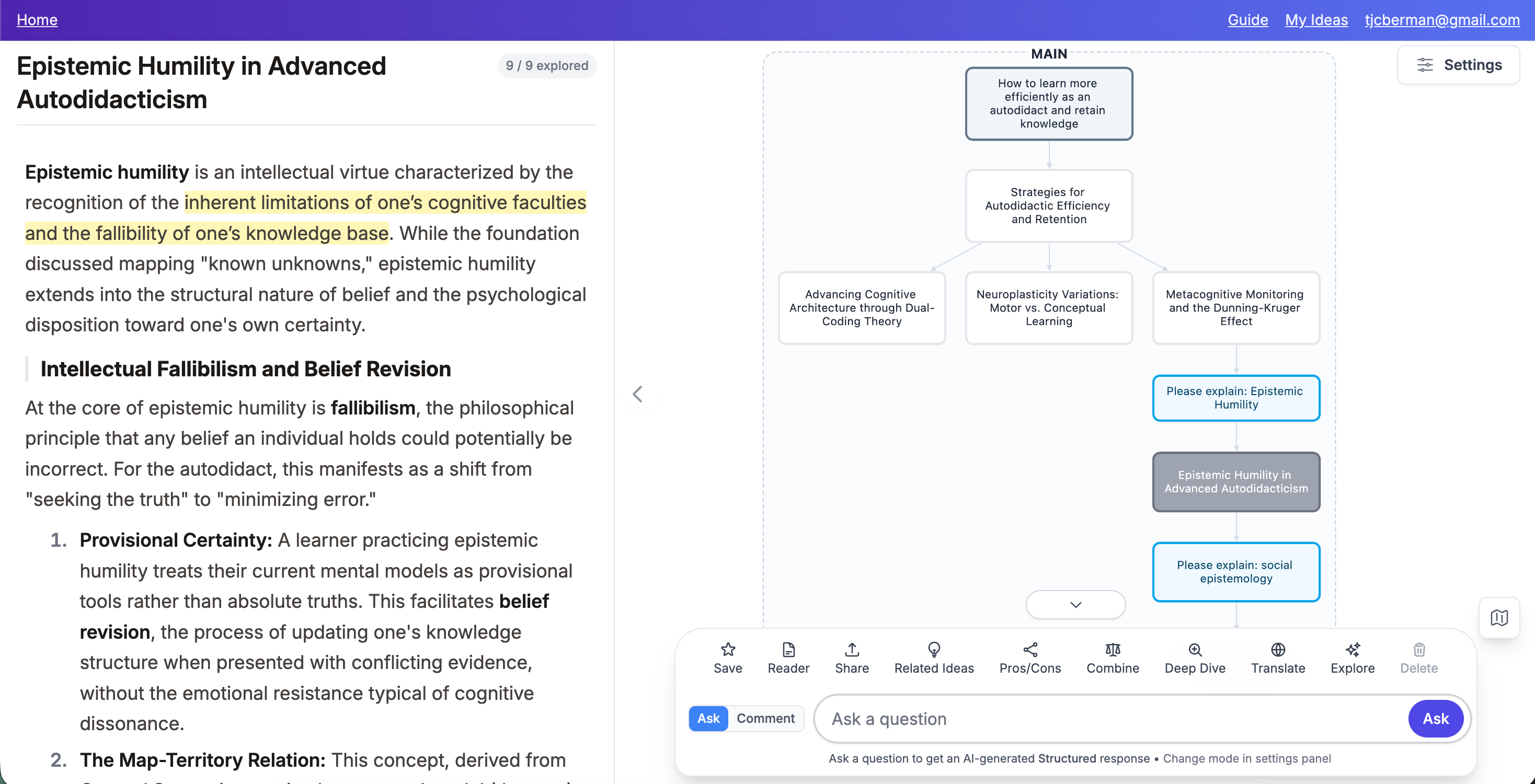
MuDG screenshot
What changes when you map the argument?
1) Structure becomes visible.
In MuDG, each reply becomes part of a shared diagram you can reference later. That means the conversation can accumulate without collapsing into “where was that message again?”
2) Collaboration stops being a race.
MuDG is designed so you can invite others into the same map to add questions, examples, and perspectives in real time—without their contributions becoming tangled in one linear feed.
3) The output becomes reusable knowledge, not an ephemeral moment.
MuDG leans into persistence: instead of fleeting exchanges, it aims to create evolving knowledge graphs that build value over time.
Practical features that make this more than a philosophy
If this is going to compete with chat, it has to do the boring stuff well:
An interactive visualisation of ideas and their relationships (not just a transcript).
Action tools for common thinking moves—pros/cons, exploring related ideas, combining concepts, translation, deep dives—so structure isn’t a tax, it’s a shortcut.
Unique URLs for every graph and even every node, so you can share the exact point you mean, not “scroll up until you see it.”
Private graphs with access control when the topic is sensitive.
Export to PDF, PNG, or Markdown so the thinking can leave the tool and live in your documents, teaching materials, or notes.
There’s also a classroom-shaped version of this idea: teachers can create a diagram, lock it, and share it so students explore a designed learning path (or build competing diagrams and merge the best claims into a synthesis).
In other words: MuDG isn’t trying to be “a better chat.” It’s trying to be a better container for thought.
Compare and contrast: when chat wins, when maps win
Chat is the right shoe when:
speed matters more than completeness,
the goal is coordination, not understanding,
the group is small and aligned,
and losing context isn’t expensive.
A mapped conversation is the right shoe when:
you’re exploring a complex topic,
you expect disagreement or multiple lines of argument,
you need a durable record of “how we got here,”
or you’re teaching / learning and want others to follow the reasoning later.
The point isn’t to replace chat. The point is to stop treating the stream as the default interface for every kind of thinking.
Because the stream has a trade-off.
And once you see it, you can choose something better—when “better” matters.
A closing thought
We’ve spent a decade perfecting tools for talking quickly.
Now we need tools for thinking together.
MuDG is one attempt: take the parts of conversation that matter—claims, reasons, evidence, counterpoints—and give them a shape that can survive time, scale, and disagreement.
Give it a try: